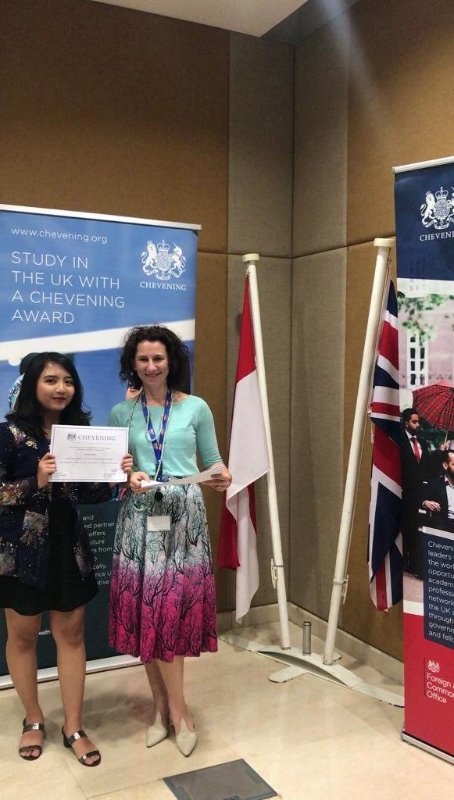
I was sitting on my couch wondering if I was worthy of scholarship to study at one of the universities in the UK. Failure after failure somehow took a heavy toll on me, but somehow something happened. On the last day of submission deadline, my fingers were tingling and unbelievably started to type something. One word a time, sentence to sentence, and eventually three essays were finished.
Ideas do not come fully formed especially during last minute but it had been in my head longer than I could remember, so even in a rush I knew what I wanted to say and how to say it. If you think I’m a hella lucky deadliner, you’re partially wrong. Yes, I’m lucky. I finished the application within 3 hours but the truth is I have been preparing for it for years now. I have been a recipient of various scholarships and also been rejected a few times, but I have never encountered experience like what I have with Chevening. Let me tell you about the very beginning of my pre-Chevening journey.
Phase 1: Reading the requirements of Chevening scholarship and having the urgency to apply
In the beginning, I told myself it wasn’t for me. I bet you will be overwhelmed the first time you read, as I did.
Here is the full eligibility for Chevening Award from the website:
- Be a citizen of a Chevening-eligible country. Indonesian is of course eligible.
- Return to your country of citizenship for a minimum of two years after your award has ended. Guys, this is important. Chevening wants you to contribute to your community, to your country after your study in the UK.
- Have an undergraduate degree that will enable you to gain entry onto a postgraduate programme at a UK university. This is typically equivalent to an upper second-class 2:1 honours degree in the UK. For Indonesian, 2:1 honours degree is GPA 3.0 and above. Full information about UK grading equivalence is here.
- Have at least two years’ work experience. When we think of work experience, we instantly think that it is the job we take upon graduation from college. But Chevening counts part-time, internship, volunteering as work experience too. Detailed information about this, please open the website here.
- Apply to three different eligible UK university courses and have received an unconditional offer from one of these choices by 12 July 2018. In my case I had two LoA’s on my hand.
- Meet the Chevening English language requirement by 12 July 2018.
You don’t have to have english language requirement, unconditional letter of acceptance, or 2 references when you apply for Chevening. English language requirement and letter of acceptance from university will be the ‘condition’ if you have been successfully selected. Recommendation letters are needed when you make it to interview stage.
When completing the application, you will have to answer questions (kind of short essay) about study, career, leadership, and networking. I guess, that is where you need to allocate most of your time to think about what you can possibly write in less than 500 words for each section.
Phase 2: FINALLY typing something, several hours before the deadline
I’m really, really not proud of my procrastinating skill but it helps me to push thinking creatively. I work best under pressure or when challenged. Well, this was one hell of a challenge. In my case, I have always carried my ‘life brainstorm’ everywhere I go. I have written an essence about my life in bullet point, CAR (case, action, result) type of structure, related to my education, career, networking, organizational experience, family background, many more, so I can take some parts of it and tailor it into another format of writing as per requirements or needs. Also, I’ve already got IELTS score and letters of acceptance from the university.
Probably what worried me the most was that the deadline was approaching and I still wasn’t happy with my essay. Then I remembered that I’m “perfect is better than done” person, which is bad, cause it takes 2 gazillion years of thunderstorm for me to actually mark something as ‘done’. Screw it, I hit submit button. I eventually forgot I ever applied because I didn’t wish that much.
Phase 3: Receiving email that I passed the screening against criteria and I needed to provide 2 letters of recommendation
I was psyched for 2 seconds. Party’s over, I needed to ask a huge favor from people who knew me pretty well and would likely speak highly of me, aside my parents. I listed potential people I could reach and I came down to my boss and my professor. Thank God, they’re very, very generous that they kinda wrote love letters about me.
Phase 4: Invited to interview at the British Embassy in Jakarta
If you’re invited to interview, it means that they like what you answered in the application. I went from being a skeptic into a believer that this might be something I could achieve. When that thought emerged, that’s when I started taking it more seriously.
My Chevening interview at the embassy was exactly the next day after my 2-week backpacking trip in ASEAN. I had been planning this trip even before I applied for Chevening. Thank God, my interview date didn’t overlap with my trip. But, I didn’t have enough time to practice the interview. Although I did my homework by researching for something that could help my answer to sound smart, I ended up not going down that road. The quest to whether I sounded dumb or not bright enough during the interview, I couldn’t care less. I was all-in in that room, I was all me.
Phase 5: Receiving conditional award letter
I cried like a baby. It was too hard to believe that I was #chosenforchevening. Not that I wasn’t grateful, I was overwhelmed with so many emotions. The next thing I knew, I woke up the entire house and made them awake until dawn, and that’s how happy my family was for me. I don’t have the exact number for this year, but looking from official news from previous years, the acceptance rate from year to year is probably around 1.8%. This year, there 66 Chevening scholars 2017 from Indonesia out of 4000 applications.
So, how did I get it?
Focus on what matters and stop sweating over small things.
Ha, what a shocker! But seriously, we spend ridiculous amount of time overthinking something that will or will not happen. I’ve heard a lot of people saying:
“IELTS is effing hard, I will never reached band 5.5″
Well, yes if you’ve never seen IELTS questions. It is really hard to foresee something you don’t know. But once you know what you’re dealing with, you will have the capacity to ace. I personally think 5.5 is achievable. With certain effort you put into it, you will meet the language requirement in no time.
“How will I get a recommendation letter? Who is nice enough to give me one?”
I’m sure it is hard to imagine who’s the right person for this and how to ask it in your head. Here’s what I did. I listed all of my options: my professors at college, my former supervisors, my bosses, all who knew my capabilities and of course someone who’s likely to write something nice about me.
“Will my dream Uni accept me? That’s like top 100 university in the world.”
Unless you graduated from Harvard, MIT, Oxford, Ivy League, you have every right to worry about this. My undergraduate university probably ranks 2000th in the world, but I did okay with master degree applications. Yes, of course, I didn’t apply for Oxford, otherwise I might tell different story. But the point is, pick the best school that you think the most suitable for you and just forget the rest. Just finish the application, one step at a time. You can worry about the results after you submit. Believe me, you will never submit if you think of the outcome that you didn’t give a shot yet.
“My writing sucks, I will never be able to write a good essay.”
Can I high five you first? I won’t deny it is hard, my writing still sucks even I’ve been blogging for 12 years. I promise you, you will get a better sense of writing what’s important and what’s not, how to form a sentence and craft your story into words, when you have read and written a lot. It is also critical to have someone to proof read or kindly give you constructive feedback on your writing. I have benefited a lot from the kindness of people who have provided such invaluable input for my writings, I’m sure you can ask people the same. Only if you ask.
“I’m just simply out of the league”
I thought I was too! I knew my chance of success to get the scholarship is 0.000028182818%, yes that’s a random number of a very insignificant probability. No, the universe does not conspire for something to happen or not to happen. If I hadn’t get my butt off the couch and worked on my application, I wouldn’t have been writing about this. Even though it was only 0.000028182818% chance to happen, it was still greater than 0. Sure, it doesn’t hurt to try. What hurts is knowing the outcome from trying differs from expectations. After all, it’s worth trying.
I guess it is completely normal to have certain estimation of chance of success by looking at the high profile of the scholars and thinking, “who am I to deserve this award?”. My fellow Indonesian scholars are leaders in their own fields, ranging from diplomats do doctors, engineers to entrepreneurs, managers to lawyers. It is insane how I got it, I’m just a startup hustler.
It doesn’t hurt to try, although it can be painful to fail. But only a little, cause you will forget anyways. It is always better to fail than imagine ‘what could have happened if I tried’. What’s my cost of not trying? Not going to the University of Manchester with major in Msc programme in Operations, Project, and Supply Chain Management for 2017 intake. I am still glad and grateful that I took my chance.
If I could sum up how I got Chevening scholarship to study in the UK it would be (1) stop sweating over small things and focus on what matters and (2) just participate in every process and give your all-in.
Chevening application is open now and I really wish that you can be the next Chevening scholar. For more information check out the website here.


 muthiyaalfah.com
Leave a comment